
Standardized Testing for College Admissions
Standardized Testing for College Admissions- Overview
Standardized admissions tests are exams used by colleges as just one part of a student’s application. Since the COVID-19 pandemic, many colleges are recognizing that standardized tests are not the best barometer of student success and these colleges are now “test optional”, meaning they do not require test scores for admissions.
What is “test optional”? For the current seniors (Class of 2026), many colleges “test optional”. Some colleges, such as Brown, Harvard, CalTech, Dartmouth, and a few others have returned to requiring test scores be included for admissions. A few public college systems have returned entirely to testing, including the public colleges in Georgia, Florida, and Tennessee. Many international colleges also require or encourage testing. It seems a majority of colleges nationwide will remain test optional for the Class of 2027, while others will return to requiring testing. Many colleges have not yet announced their testing policies moving forward, and will do so in the months to come. This database shows current test optional and test free policies. Here is a list of current test required colleges.
What are the SAT & ACT? In the college admissions process, these are two main exams: the SAT and the ACT. Both SAT and the ACT are considered equally by colleges in the admissions process. It is entirely up to student strength & preference which exam they focus on. Both the ACT & SAT are undergoing major changes in formats.
When can I take the exams? These exams are offered only on specific dates and are taken over the course of the 11th grade year. For students to give themselves the best opportunity to perform their best on the exams, it is recommended that students should plan to take the test of their choice (SAT or ACT) at least 2 times.
Should I take the SAT or ACT? Again, these exams are not necessarily required for admissions, and students can make a plan to apply only to test optional colleges or other non-testing programs, if they do not want to take the exams. In the end, it is up to the student and family and depends on the student's future goals.
For our current 12th Grade students, the most up-to-date Standardized Testing information is here:
Scrolling down ↓ on this page, you can also find:
An Overview of the PSAT 10 & PSAT/NMSQT
The SAT & ACT Explained, including new exam formats
Test Optional & Current Testing Policies
Steps to Making a Testing Plan
Picking Test Dates & Registering for the SAT & ACT
Sending SAT or ACT Scores to Colleges
Applying for Testing Accommodations
PSAT & PSAT/NMSQT
The PSAT 10 and the PSAT/NMSQT are standardized exam meant to give students an opportunity to practice and become familiar with the content and format of the SAT, one of the primary exams used for college admissions. (The "P" stands for “preliminary” SAT). These exams should be thought of primarily as a way for students to prepare for the SAT, which students take in 11th grade - usually in the spring semester - by experiencing the format, content, and style of the SAT exam.
NYICE offers students both the PSAT 10 in 10th grade and the PSAT/NMSQT in 11th grade, as opportunities for students to practice for later exams.
In 11th grade, students can also take the PSAT/NMSQT to try to qualify for the National Merit Scholarship. Please read below for more on National Merit. Comprehensive information on the PSAT/NMSQT is in the student guide, with scholarship + merit program information detailed beginning on pg. 57.
What is the National Merit Scholarship Program?
Students who take the PSAT/NMSQT (only in the fall of 11th grade, not in 10th grade) are eligible for the National Merit Scholarship, an award that is given to the very, very top percent of PSAT/NMSQT performers.
Students in the very top percentage of PSAT/NMSQT are selected as “commended scholars”, of that pool about ⅓ are selected to continue on as “semi-finalists”. After additional steps, students may be considered a “finalist”. Of these “finalists” , a smaller group is selected as “winners” of the National Merit Scholarship.
The National Merit Scholarship award for students who are selected from the pool of finalists as “winners” are awarded a $2,500 scholarship. Some colleges or businesses might offer additional scholarships for students based on National Merit qualification. The National Merit Scholarship is not the primary source of scholarship or financial aid for college.
More on the PSAT/NMSQT here: https://satsuite.collegeboard.org/media/pdf/psat-nmsqt-student-guide.pdf
SAT & ACT Exams
The SAT and ACT are both accepted by all colleges, just some students are a better fit for some students. Think of it like Pepsi & Coke, just two versions of the same thing. Students can pick one to focus on, or they can take both (typically we recommend picking and preparing for either the SAT or the ACT). The college doesn’t care which one you take!
PLEASE NOTE: both the SAT and ACT are undergoing major changes in format right now! The SAT has already made the transition, introducing the new exam in spring 2024, while the ACT just made major changes with the new exam being piloted in 2025. More about the new (“Enhanced”) ACT below.
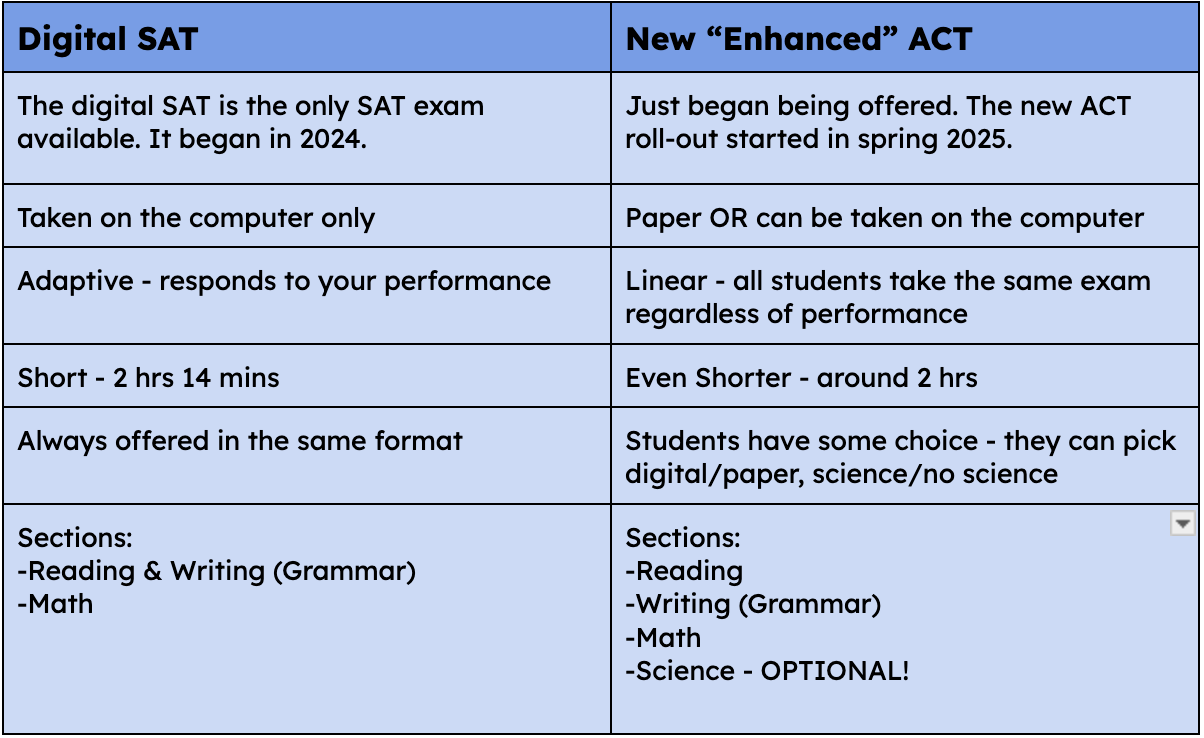
The Digital SAT (introduced spring 2024)
ONLY offered digitally!
Is an “adaptive” test (responsive to questions) - after taking a section, the next section offers harder or easier questions based on your performance
Is shorter than the previous SAT, now 2 hours and 14 minutes
More time per question (average of 1 min 22 sec per question)
Format: Students take two reading & writing sections, followed by two math sections
Reading comprehension section is short passages followed by 1 question
Math section includes many topics, but comparatively more Algebra
Scored out of 1600 points (800 for Math, 800 for EBRW - reading & writing)
Sample test & practice questions available on Bluebook here.
The New ACT (started rolling out in 2025)
Offered digitally and on paper
Is linear - all students have the same test, regardless of performance
Is shorter, now 2 hours and 5 minutes
Format: All students take a reading, writing (grammar), math
The science section - which is unique to the ACT - is optional. Students can elect to take it or not.
Compared to the original ACT, there will be less advanced math questions + students will have 4 (not 5) answer options
Scored out of 36 points (a composite score is the average of 3 section scores, science is reported separately
Free ACT practice tests & questions, available here.
This New ACT is BRAND NEW. We as counselors, and many colleges, are still figuring out exactly what to do with it! Here are some helpful resources I recommend you read to learn more - an explanation of the different options within the ACT from Compass Prep and a review of which colleges are requiring the science section of the ACT.
A Quick Summary of the Two “New” Exams
Which one should I pick?
It is often recommended that students select one of the two exams they want to focus on, the SAT or the ACT. While students can take both–and prepare for both if they want to!–it can also be helpful to narrow test prep by focusing on one of the two exams
Right now, with all the changes, it is hard for counselors to advise which exam is better for the student - this is our first year with the new ACT exam. One way to start is taking practice exams, linked above. You can also consider your own strengths – for example, if you want to take a paper exam, you’ll need to take the paper ACT. If you want to take an adaptive exam, you’ll need to take the SAT.
Which one is best for me? In the end, you should focus on whichever of the two exams better suits your learning style and preferences. If you’re unsure, take a practice test or section of a practice test for both to compare!
Making a Testing Plan: SAT & ACT
If testing is going to be a priority for your application process, it is VERY important that you make a plan and stick to it!
Here are the key steps you must take to have a testing plan:
Decide if you want to take the SAT, ACT, or both - read more above
Select test dates & register for exam dates
Make a plan to study
Picking Test Dates: SAT and ACT exams are only offered a limited number of times each year. Many students plan to take the SAT or the ACT for the first time in early spring of their 11th grade year. I’m going to call this a “regular” schedule. Some students choose to take the SAT or the ACT beginning December of their junior year, on what I’m calling an “early” schedule.
Most students who plan to take the SAT or ACT take it multiple times, often 2-3 times. Below are some sample schedules of what a testing plan could look like (for the Class of 2027)
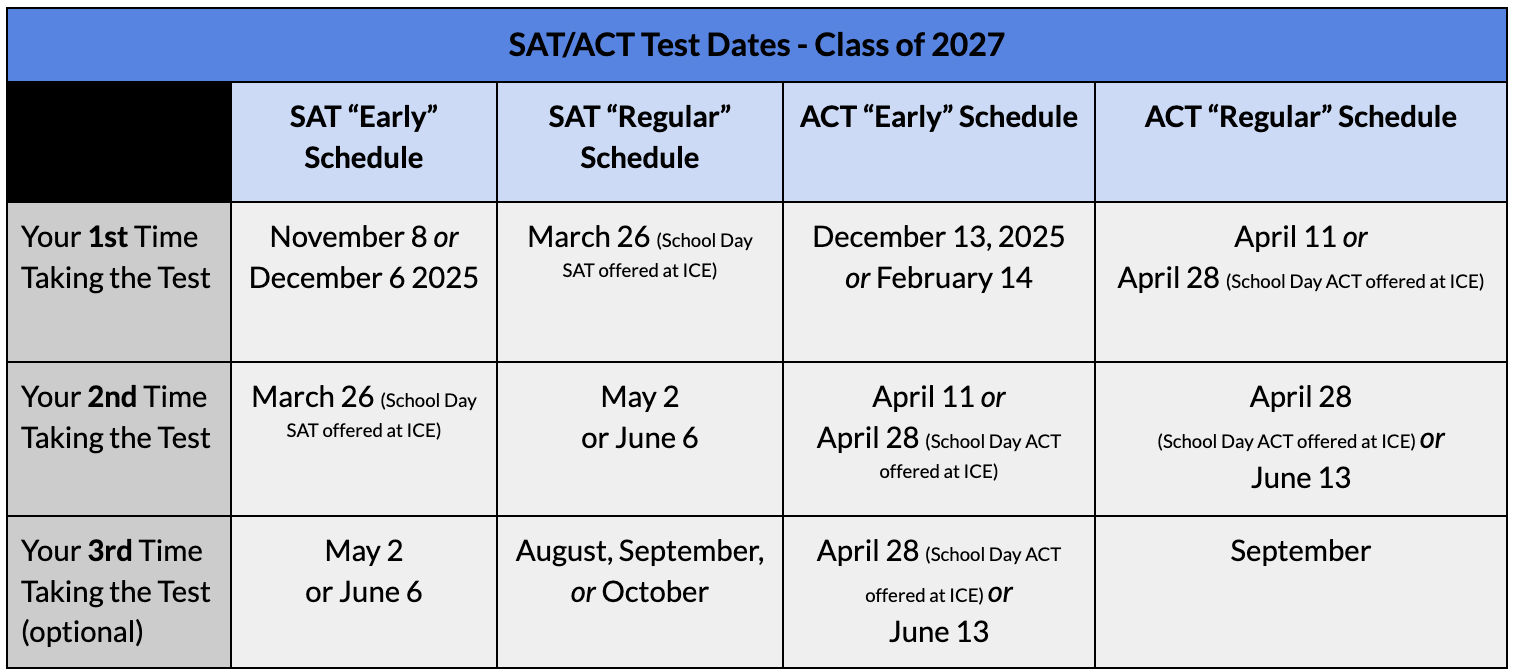
FREE SAT & ACT School Day Exam: The SAT & ACT School Day exam is a special administration of the exam that is offered 1 time per year for free during the school day at ICE in the spring for 11th graders. Sign up is done through ICE.
All Other Test Dates: For every other SAT or ACT exam date(s), students and parents must register directly through the testing company. These test dates are offered at different testing centers on Saturdays.
To Register for the SAT or ACT, you'll need…
SAT Dates ; Register for the SAT + Helpful video for how to register.
ACT Dates; Register for the ACT + Helpful Video for how to register.
About 30 minutes
Our School CEEB Code: 333672
A “Headshot” Photo (take against a plain wall)
Fee Waiver Code (if you qualify - more below)
**You do not need to complete everything requested of you during the registration process. You can often click “continue” at the bottom to skip questions that are not required.
**If you are registering for the ACT, they will ask if you want to register for the essay portion. Because the SAT recently discontinued the SAT, in almost all cases the recommendation is to NOT register for the ACT essay section. More here.
Picking Test Dates: SAT and ACT exams are only offered a limited number of times each year. A vast major of students plan to take the SAT or the ACT for the first time in early spring of their 11th grade year. I’m going to call this a “regular” schedule. Some students choose to take the SAT or the ACT beginning December of their junior year, on what I’m calling an “early” schedule.
You may want to take the exam on the “early” schedule if you already feel very prepared for taking your standardized tests, and you want to get it over with and behind you!
You plan to be a recruited athlete, and you want to be able to share SAT or ACT scores with coaches early in the process.
Fee Waivers: Students who qualify for free & reduced lunch receive fee waivers for FREE SAT & ACT testing. Please email Molly or Wali or pick up in the Future Pathways (Room 522B) if you think you qualify. In order to receive a fee waiver, you must have a lunch form filed each year: https://www.myschoolapps.com/Home/PickDistrict
With a fee waiver, you can take the SAT 2 times for free (in addition to the School Day SAT) or the ACT 2 times for free.
Testing Accommodations for Students
As for students who qualify for testing accommodations, there must be a request for accommodations submitted to either the SAT or ACT, depending on which exam they plan to take. To submit the request for accommodations, your family must sign a consent to release information form, which you can access by using either of the following links, depending on which exam your student is preparing to take in the spring. Once signed and completed, the form should be returned to Wali in the College & Career Office, at which point he'll go forth with submitting the request (wali@iceeducate.org).
It's important to note that submitting accommodations for the ACT requires more extensive documentation and often takes longer to get approved, sometimes several months. Additionally, ACT requests aren't approved with the same success rate as SAT requests, so if your student is preparing for this exam and qualifies for accommodations, you should submit the consent form as soon as possible.
Contrarily, the SAT usually accepts requests as long as adequate documentation is on file at the school, which we'll have if your student qualifies for accommodations. Either way, we recommend submitting the consent form(s) before December, so there is ample time for the requests to be submitted, reviewed, and ultimately approved.
Consent Forms: SAT Consent for Accommodations Request //ACT Consent to Release Information to ACT
Test Optional & Test Blind Policies
Test Optional: This means that these colleges do not require standardized test scores when they review applicants; students will have the option to decide if they want to submit their scores for consideration. If scores are submitted, the college will consider; if they are not considered, they will focus on other components of the application, especially the academic transcript, as well as extracurriculars and recommendation letters.
The pandemic has drastically increased the number of test optional colleges. For the Class of 2024, almost all private colleges as well as our state public college system (SUNY) were test optional. Some colleges have announced plans to continue being test optional for several years, but many are only test optional for the current senior class. A full list of test optional colleges here.
Some colleges may require additional supporting materials if you choose to apply test optional. For example, a college may require an additional piece of writing only for students who select that they intend to apply TO.
Test Blind Policies: The truly equitable move from colleges is to take on a “test blind” policy, meaning that -- even if submitted -- they will not review test scores. This is different from the “test optional” policy discussed above, in which colleges will review students’ test scores if submitted. However, unfortunately, most colleges will likely not adopt this policy. A few colleges have opted for “test blind” policies, such as the UC system and Worcester Polytechnic Institute.
Test Optional - Send or Not to Send? When you’ve finalized your college list, you’ll need to make a decision for each college (if the college is “test optional”) if you want to send your SAT or ACT scores or not. A general rule of thumb is that your SAT or ACT scores should be at least within the median 50% range for the college if you plan to send your scores. Again, this data can typically be found on the college’s website or through this database. Highly detailed data can be found by finding the colleges Common Data set information (Google: Common Data Set + College Name).
Don’t forget… Check Specific Major or Program Requirements! Some colleges may have specific testing requirements or higher score ranges for selective programs, such as engineering, nursing, business, etc.
Still not sure? Have a conversation with Molly about any schools you're not sure about.
Scoring & Sending SAT or ACT Scores
How to Send Scores to Colleges: Once you begin to apply to college, it is the student’s responsibility to send their SAT or ACT scores to colleges. The College Office does not send SAT or ACT scores. Colleges accept scores in several ways, and it is the student’s responsibility to identify the method by which they will plan to send their scores, if they intend t o include them in their application. Scores often take 1-2 weeks to process, so make sure you send your scores before the application deadlines!
Official Score Send through College Board (SAT) or ACT.org (ACT). For each college you apply to, you need to pay (or free with a fee waiver) to send your official SAT or ACT scores. These official score sends can be done through the College Board website or the ACT website.
Self-Reporting (on the Common App, application portal, or other method). Self-reporting means that instead of sending your official SAT or ACT score report to a college, you instead can “self report” (on the application or elsewhere) your SAT or ACT scores. The college will only request official scores if you are admitted. It is important to identify how the college wants the self-report scores provided. The (growing) list of colleges that will accept self-reported scores is here (far right).
Which Scores Get Sent? Do I need to send ALL my scores? Most colleges participate in score choice” or allow students to only send test dates that reflect their highest scores. This article does a good job summarizing this policy & lists the notable colleges that require all scores be sent. You can find a list of colleges that allow score choice here.
Superscoring & Other College Scoring Policies: Superscoring is the process by which colleges consider your highest section scores across all the dates you took the SAT or ACT. Rather than confining your scores to one particular date, these schools will take your highest section scores, forming the highest possible composite score. Some colleges have different superscore policies for SAT & ACT. College superscore policies here.
SAT Superscoring: For the SAT, the superscore is made up of a student’s highest Reading & Writing Section (EBRW) and Math (M) scores.
ACT Superscoring & Score Choice: For the ACT, the superscore is the average of the 4 main section scores. Again, incredible detail about new ACT superscore reports here.
Test Optional - Send or Not to Send? When you’ve finalized your college list, you’ll need to make a decision for each college (if the college is “test optional”) if you want to send your SAT or ACT scores or not. You can choose which colleges to send your scores to, and which you do not want to send your score to. A general rule of thumb is that your SAT or ACT scores should be at least within the median 50% range for the college if you plan to send your scores. Again, this data can typically be found on the college’s website or through this database. Highly detailed data can be found by finding the colleges Common Data set information (Google: Common Data Set + College Name).
This guidance (parsed from Grinnell's website) summarizes some considerations:
If you think your scores are an accurate representation of your ability, then you should feel free to submit them. If you feel they are not, then don’t submit them.
If you get the score you hoped for, and especially if it’s above average [for the college], submitting the score may help you in the admission process.
Test scores are considered in context. Even if your score is not above average for [the college], but it is for your high school or neighborhood, your score may help you in the admission process.
A high SAT or ACT score can offset a low GPA*. If you don’t submit a score, we have less information about your academic performance. If you have a low GPA but do well on the SAT or ACT, your test score can be an important indicator of your potential to succeed in college-level classes.
We also recommend you check data on the individual college about what % of students they accept without test scores, to better understand the individual college’s policies.
Other SAT/ACT Prep Resources
Revolution Prep - Revolution Prep SAT or ACT
Description: This is the company that we offer our ICE SAT or ACT prep through. Students and families can also register for group tutoring through Revolution Prep outside of ICE. Cost: from $499 for small group (8 students) tutoring
Khan Academy - Khan Academy SAT
Description: Free SAT prep online for students. Includes practice tests and targeted questions based on student performance. Digital SAT practice is also available on the Bluebook practice testing app.
Cost: Free!
Let’s Get Ready - Let's Get Ready
Description: Near-peer led prep for SAT exam, offered in addition to personalized goal-setting and introduction to the college admissions and financial aid process. Applicants accepted on a rolling basis.
Cost: Free!
Baruch STEP - Baruch SAT/ACT Prep
Description: Courses in SAT/ACT prep are offered through the college’s STEP program. Applicants must meet STEP eligibility requirements. Priority deadline for spring 2024 is December 1.
Cost: Free!
Fordham STEP - Fordham STEP Kaplan SAT Course
Description: Courses in SAT Prep hosted by Kaplan for students enrolled in Fordham STEP. Applicants must meet STEP eligibility requirements. Students must apply and enroll in Fordham’s STEP program.
Cost: Free!
Columbia SPREP - Columbia SPREP
Description: A course offered during the summer or winter to prepare students for taking the SAT. Applicants must meet STEP eligibility requirements and enroll in SPREP’s program.
Cost: Free!
Applerouth - Applerouth SAT & ACT Prep
Description: Private NYC-based tutoring company, offers small groups, individual tutoring, or online self-prep offered for both SAT and ACT Prep.
Cost: from $599 (for small group) or $199 for online, self-paced
Kaplan - Kaplan SAT & Kaplan ACT prep
Description: Multiple options ranging from a Live Online 18 hour course, to a shorter boot camp, Unlimited Prep, or individual tutoring for the ACT. These options come with live online courses going over test questions along with providing practice questions and strategies.
Cost: from $549
Princeton Review - Princeton Review SAT & ACT Prep
Description: Either option comes with practice questions, strategies, and the option for online courses.
Cost: from $649
Bell Curves - Bell Curves SAT Prep
Description: Tutoring and courses are offered for SAT prep to help students analyze problems. Provides test questions and strategies.
Cost: Tutoring begins at $80
Wyzant - www.wyzant.com
Online database of services that handles the vetting of the tutors, lets you find someone in your area, read reviews, and, most conveniently for an ongoing arrangement, deals with payment for you. It's very easy to just put in a subject and a zip code and browse.
Cost: Varies
Testing Accommodations
Please contact Wali (wali@iceeducate.org) with questions about SAT and ACT testing accommodations for students with IEPs and 504s.
Links & Resources
USEFUL DATABASES.
College Testing Policy (Superscoring, Score Send)
SAT and ACT Prep On Your Own
SAT Overview / SAT Practice Questions.
SAT Full length practice exams (Khan Academy or Printable)
ACT Overview / ACT Practice Questions.
ACT Full length practice exams (2020-21 doc here, list here).
Khan Academy (Free SAT practice): getting started & explanation video
SAT and ACT Registration
Register for the SAT + Helpful video.
Register for the ACT + Helpful Video.
SAT and ACT Score Sends
NEWS + PRESS ON STANDARDIZED TESTING UPDATES
CollegeBoard announcement on SAT II + Essay
NYTimes Article About College Board Changes
The Pandemic & College Admissions
Test Optional MEANS Test Optional Statement from NACAC